Beyond the Loaf
The rest of the medieval bakery.
Twenty-three recipes from the griddle, the frying pan, the wafer iron and the feast-day oven. What the sources actually say, why each recipe works, and the grams for your kitchen.
- 23 recipes
- In five parts
- 178 pages
- 28 pictures, English e-book
- Sourced
- Legends marked as legends
14-day money-back guarantee
Look inside the book ↓
Every chapter starts with the source.
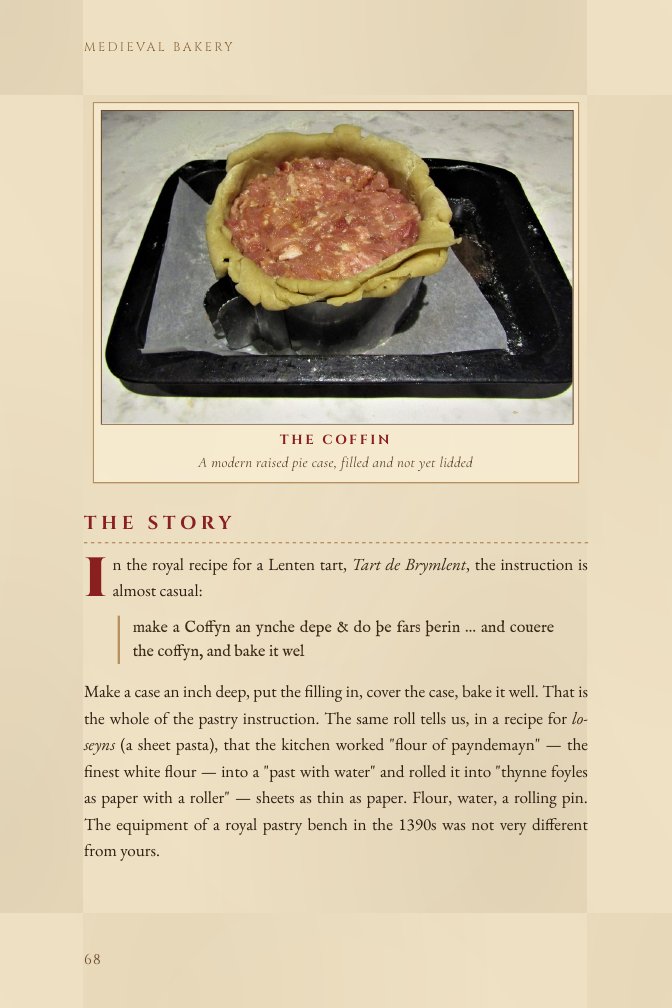
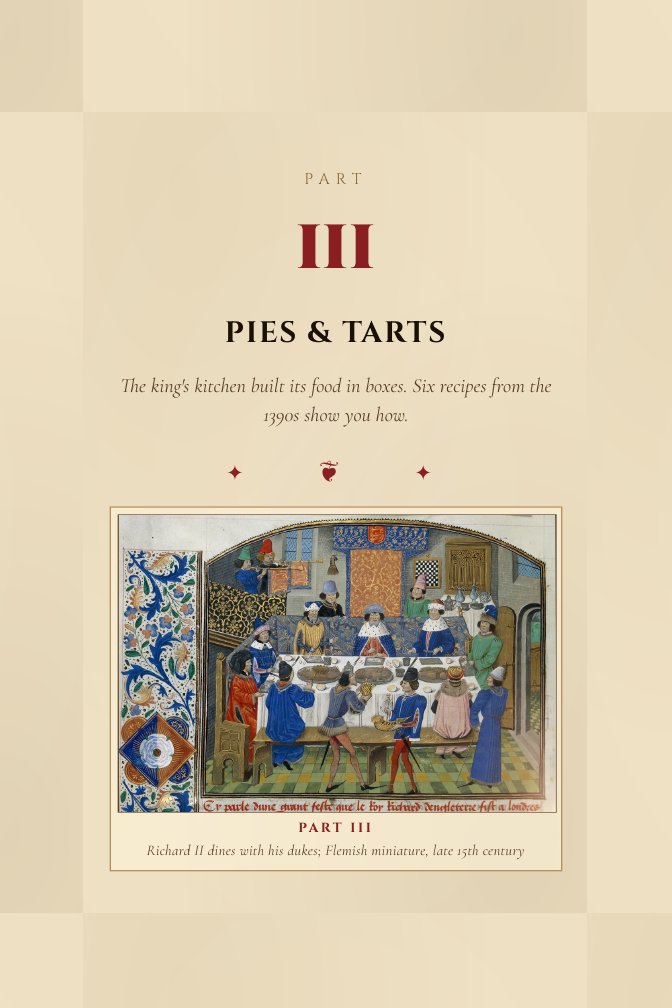
The pie chapters open with the recipe as Richard II's cooks wrote it in the 1390s, quoted in the original and translated beside it, before a single gram is given.
The words on the page
Middle English, Old French, Latin and early German are quoted from the editions, with the translation next to them.
Where the story stops
When the popular version is a legend, the chapter says so: the coffin was not thrown to the servants, the first gingerbread had no ginger.
Then the kitchen
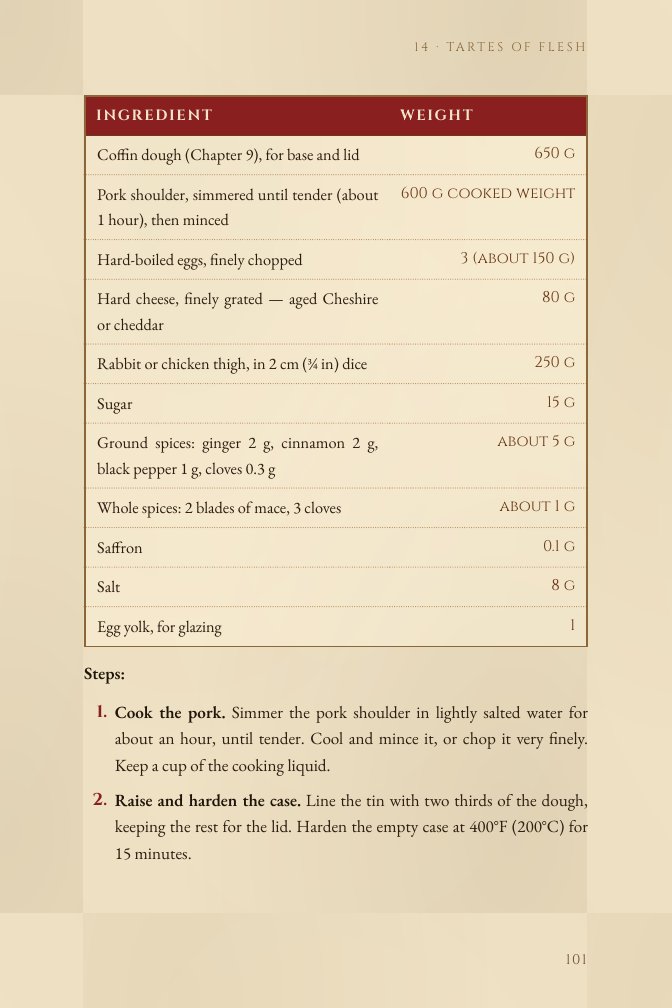
The Science explains why it works, and the Recipe turns it into grams, oven temperatures and core temperatures.
Seven more pages in the preview below.
Twenty-three recipes, in five parts.
The breads people ate when wheat was too dear, the flatbreads baked on a stone in the fire, the pies of the royal kitchen, the fried and pressed bakes of the medieval town, and the spice breads that waited all year for one season.
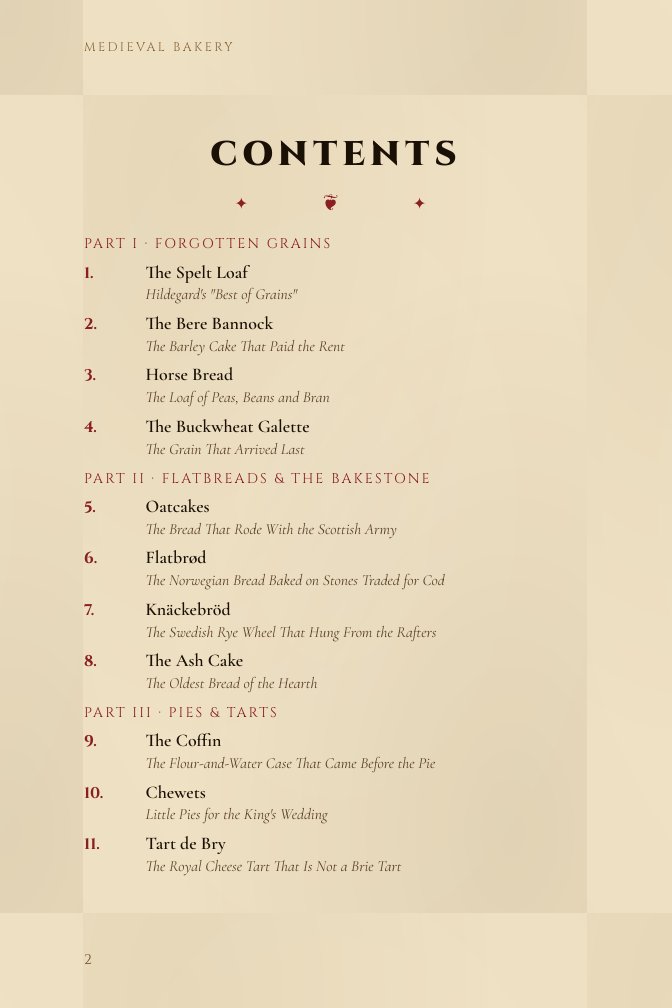
- Forgotten GrainsHildegard's spelt loaf, the Orkney bere bannock, horse bread of peas, beans and bran, the buckwheat galette.
- Flatbreads & the BakestoneOatcakes, Norwegian flatbrød, Swedish crispbread with a hole, the ash cake.
- Pies & TartsThe coffin crust, chewets, Tart de Bry, Tart in Ymbre Day, darioles, and the pork pie that became the mince pie.
- Fladen, Pretzels & FrittersBasel's English Fladen, the pretzel, Parisian crespes, the Lenten Krapfen, oublies and gaufres.
- Feast-Day BakesGyngerbrede, Lezelten baked twice, Siena's panpepato, the Christbrot of 1474 and the butter letter.
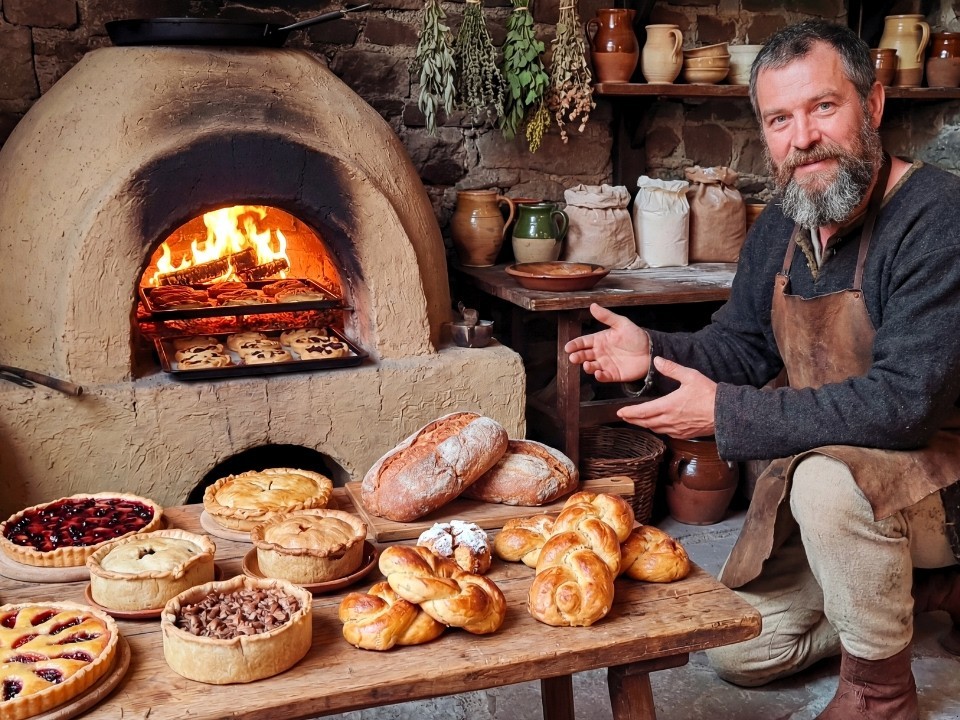
The source, the reason, then the grams.
Eight pages, as they are.
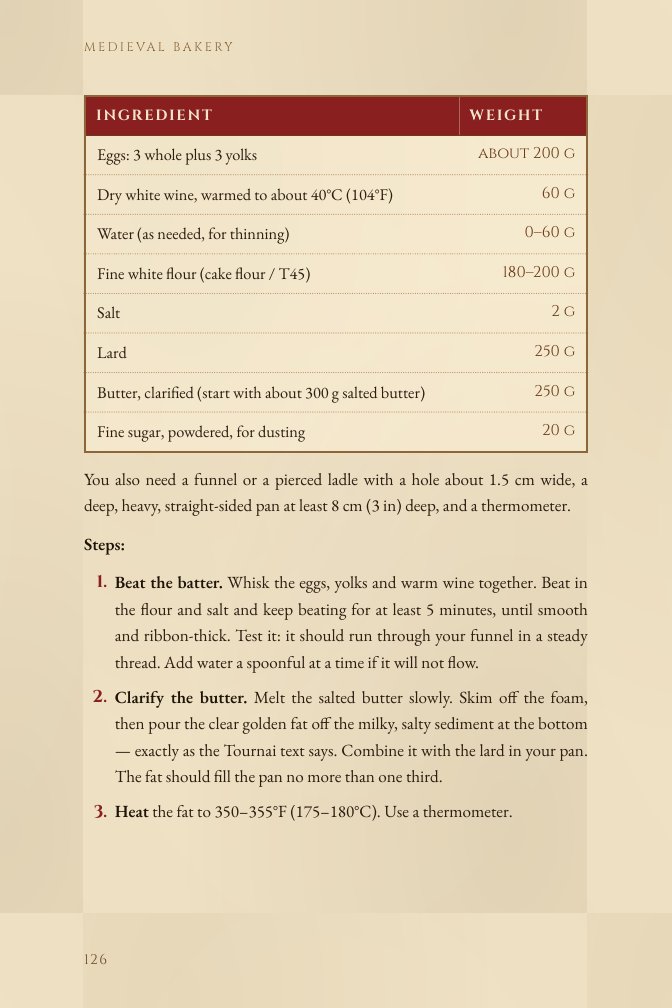
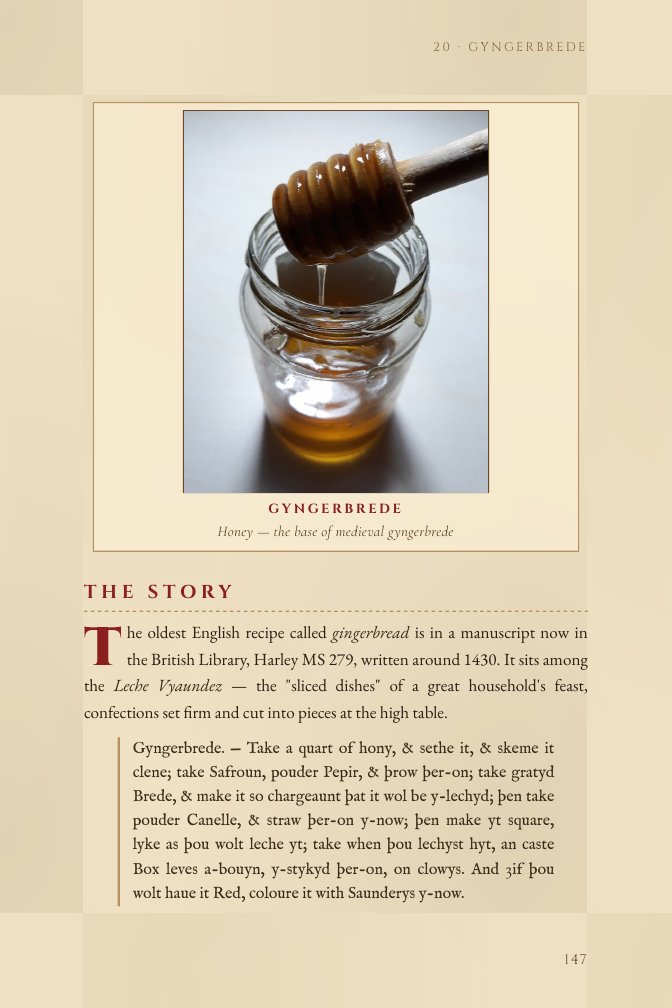
From checkout to your first bake.
- The file arrives immediately. An e-book, by email, the moment the payment clears. No account, no app, no waiting.
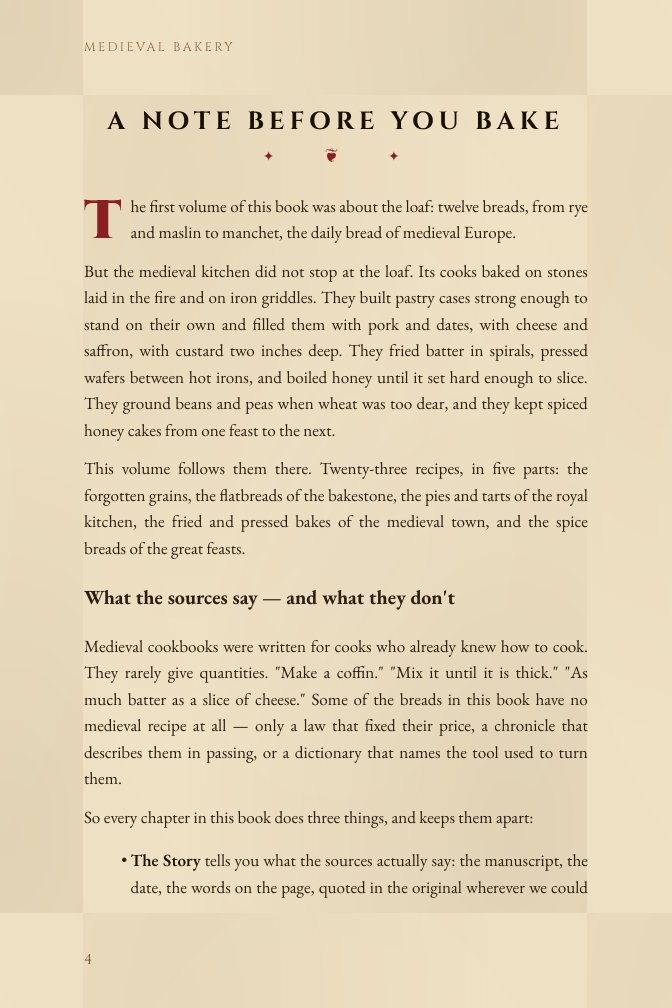
- Read “How to Use This Book”. Two pages: weights, temperatures, the probe thermometer, and why Part III starts with one pastry.
- Start on a griddle. Oatcakes or crespes need nothing but a heavy pan and an afternoon.
- Then build the coffin. One flour-and-water case, and five pies and tarts open up from it.
From the Medieval Way series to your everyday life.
Medieval Way explores traditional skills through its video series and digital field manuals. The books bring that work into a format you can return to, at your own pace.
The sample pages shown here come from the books themselves. Read the detail, explore the contents, and decide whether the approach fits what you want to do next.
Before you buy.
Do I need Volume I or the Collection?
No. Beyond the Loaf stands on its own. It picks up where the loaves of Practical Recipes stop: the flatbreads, pies, fried and pressed bakes and feast-day breads. Several recipes use a sourdough starter; the book tells you where.
Are these real medieval recipes?
Where a medieval recipe survives, the chapter quotes it in the original and translates it. Where none survives, the book says so plainly, shows what evidence there is, and labels its own recipe as a reconstruction. A few, like the buckwheat galette and Swedish crispbread, are honestly late-medieval or early modern, and the chapters say that too.
Will it work in my kitchen?
Every recipe is written for a home oven, a heavy pan or a griddle, in grams with temperatures in °F and °C. A baking steel or cast-iron pan stands in for the bakestone. Two recipes need a wafer or pizzelle iron.
What about safety?
The book gives core temperatures for everything with meat, eggs or custard, and safety boxes for hot fat, lye and the ash fire. Pretzels default to a baking-soda bath; lye is an option, with the rules written out. Allergens are flagged in every recipe that uses them.
What do I actually get?
An e-book of 178 pages with 28 pictures: a note before you bake, how to use the book, five parts with twenty-three chapters, a sidebar on the Twelfth Night bean cake, and the sources for every part.
Is there a print edition?
Yes, as a paperback and a hardcover on Amazon. The e-book is the one that arrives instantly.
Twenty-three recipes, one payment.
An e-book, delivered the moment the payment clears. It opens on anything, prints cleanly, and it is yours: no subscription, no membership, nothing recurring.
Three medieval breads, free.
The rye starter, a maslin loaf and the six-hour pumpernickel — three complete chapters out of Practical Recipes, Volume I.
The rest of the shelf.
The loaf is where it starts. These are the rest of the shelf.

Ten medieval loaves with exact weights and temperatures, the rye starter built from nothing but flour and water, and the guide to finding real grain.

How a household ate through winter without a refrigerator. Salting, smoking, drying, fermenting, burying — each method with the science under it, and the safety margins written out rather than glossed over.

Heat, light, water, storage and repair, the way households managed them before the meter. What each method saved then, what it saves now, and which of them still hold up in a modern house.

What grew in a kitchen garden before the seed catalogue — with the sowing numbers, the lookalike tests that work at the rosette stage, and where to actually get the seed.

Medieval Way: The Complete Library
All five books in one download — seven e-books in total. The bread and the bakes beyond it, the larder, the household accounts, and the garden. Everything Medieval Way has written down, and nothing left to buy later.