The Medieval Home
Make a plan for a warmer, less wasteful home.
The Savings Manual brings traditional household ideas into a practical reference: heat, light, water and a ledger for tracking what you change.
- 35 methods
- Across nine chapters
- 55 pages
- English e-book
- Printable
- Your savings ledger
14-day money-back guarantee
Look inside the book ↓
Turn a list of ideas into your own record.
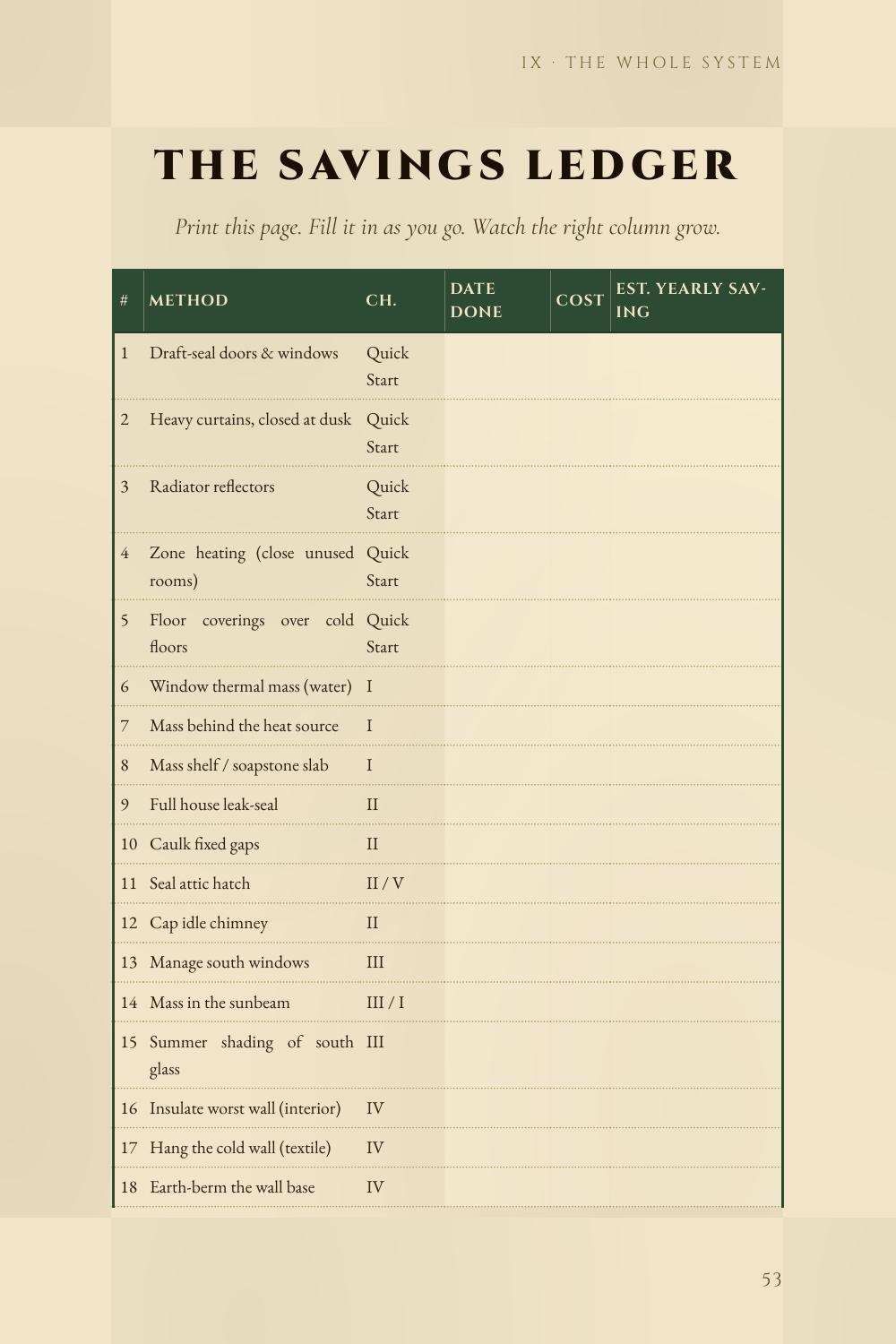
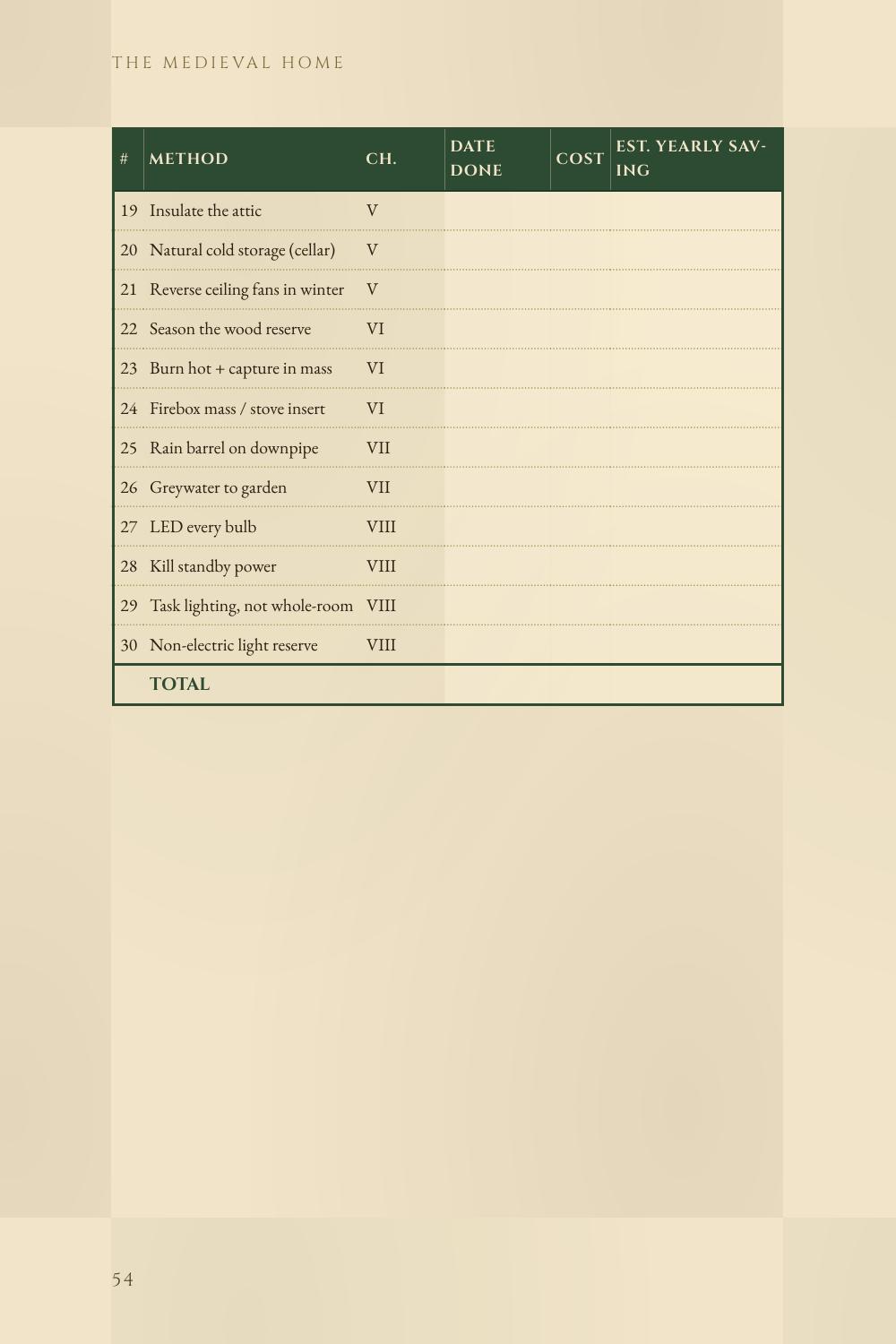
This worksheet gives each method a place in your plan, with space for the date, cost and estimated yearly saving.
Find the chapter
Each row points back to the relevant part of the manual, so you can read the method before deciding whether it suits your home.
Record what you change
Keep the completion date and actual cost beside the method instead of trying to remember them later.
Keep estimates separate
The savings column is left blank for your estimate. It is a worksheet, not a promise of what your particular home will save.
Print the ledger or keep it alongside the book. More sample pages are below.
You are paying to heat the street.
A modern house loses most of its heat the same way a medieval one did — through gaps, through single-skin walls, through a roof with nothing in it. The difference is that a medieval household could not afford to lose it, so they built and lived around the problem. We just turn the heating up.
The result is a bill that arrives whatever you do, and a house that is cold in the corners anyway. Almost none of the fixes in this book require a builder, planning permission, or a loan.
Five things you can do this weekend for under $50.
Before the history and before the science, the book opens with the part that pays for itself by the end of the month. Materials from any hardware store. Every one of them stops heat leaving the house, and every one has a medieval equivalent — they used wool, fur and shutters where we use foam and fabric.
- Seal the draft at every door and window.$12 · two hours
- Hang a heavy curtain over every window, and close it at dusk.$20 · one hour
- Put a reflector behind every radiator on an exterior wall.$8 · one hour
- Close off the rooms you are not using.free · ten minutes
- Cover the bare floor over any unheated space.$0–15 · one hour
That is chapter zero. Thirty more methods follow, arranged by what they cost and what they return.
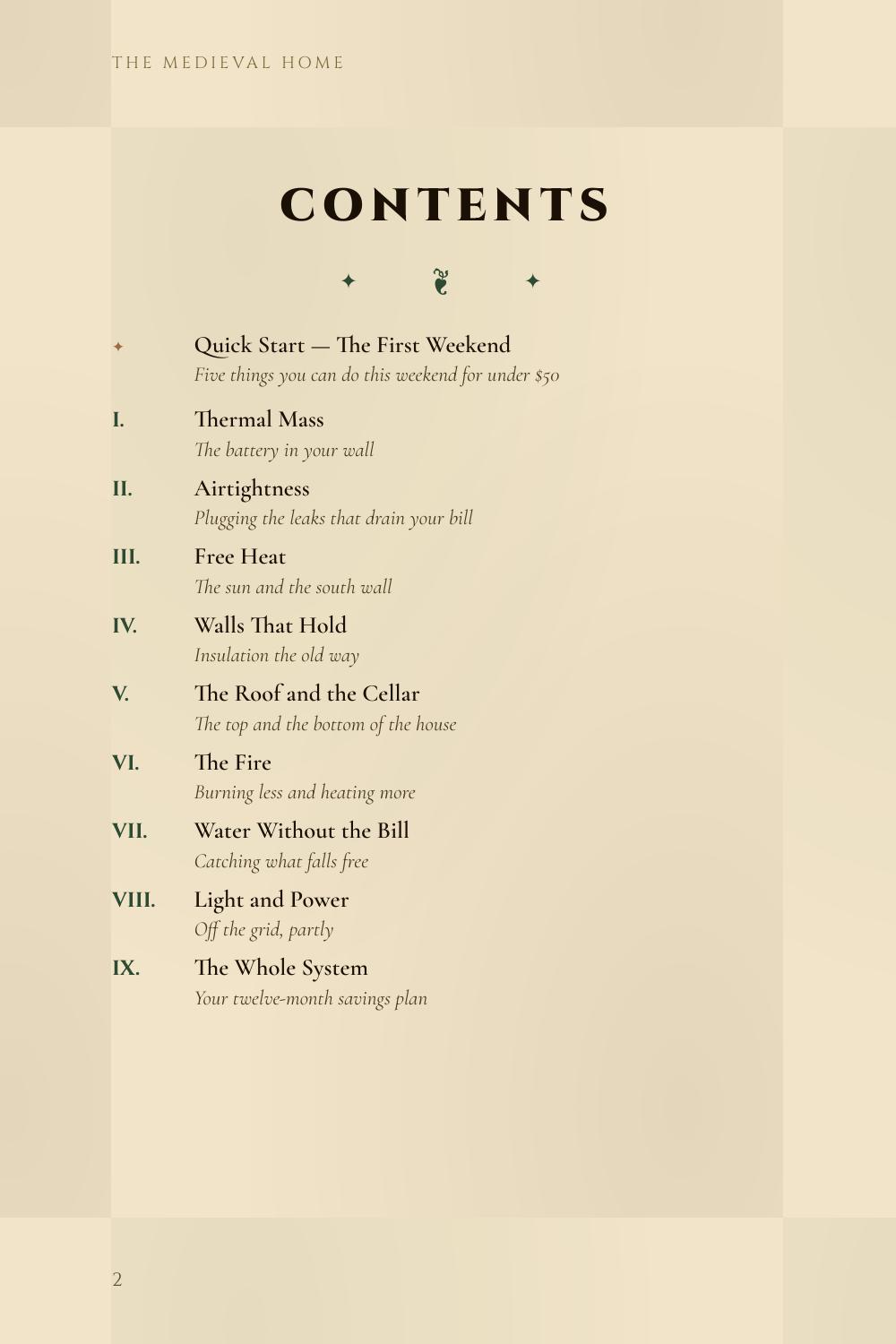
Nine chapters. Thirty-five methods.
- Thermal MassWhy stone and water hold a room steady while air does not
- AirtightnessFinding the leaks, and the order to close them in
- Free HeatThe sun through a south window, and how to keep it
- Walls That HoldInsulating from the inside when you cannot touch the outside
- The Roof and the CellarThe two ends of the house that leak most and cost least
- The FireBurning hot and short, then storing what you made
- Water Without the BillThe eaves barrel, and where greywater legally goes
- Light and PowerLighting the task instead of the room
- The Whole SystemHow the methods compound when they are combined

Turn the pages before you choose.
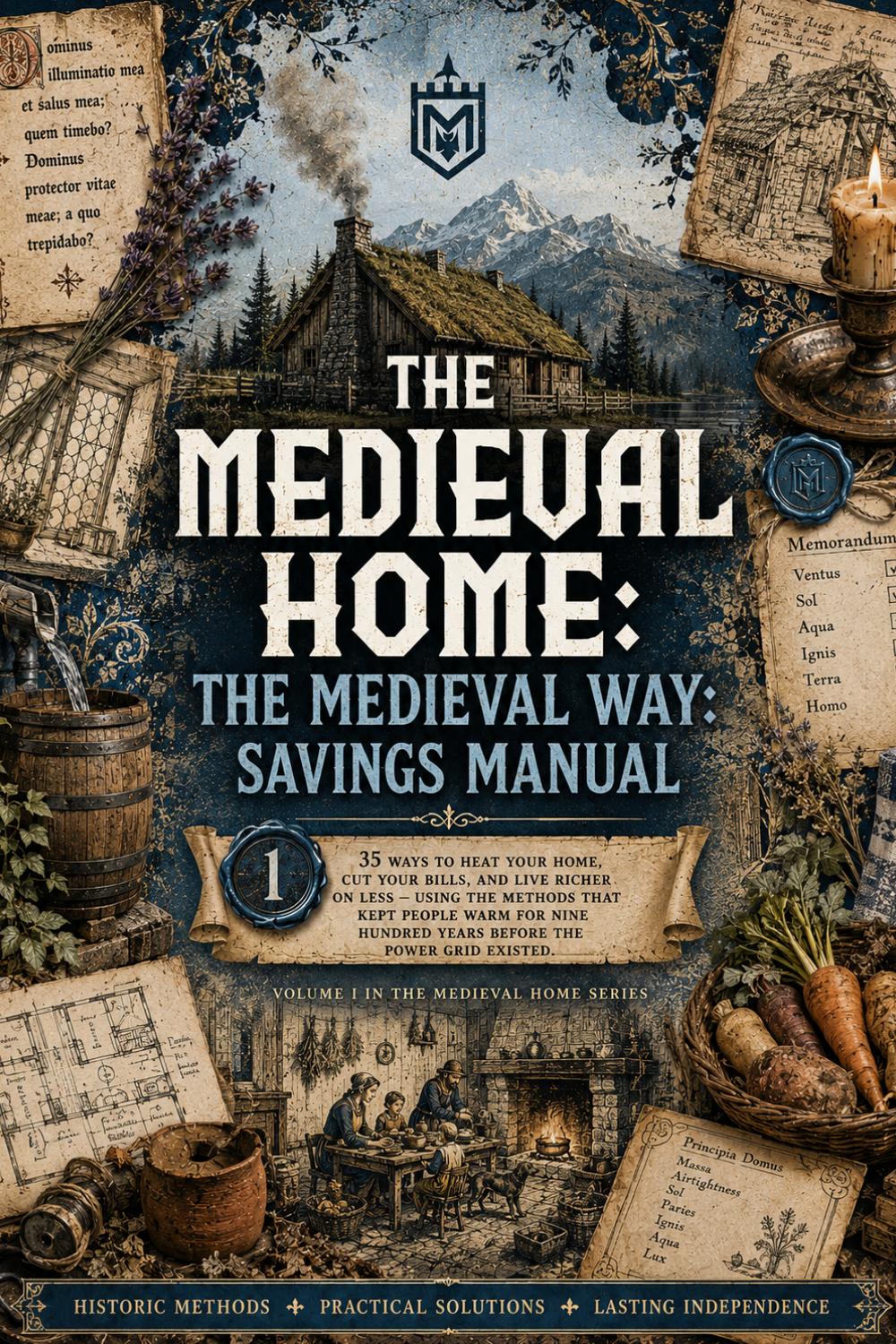
Four selected pages from the 55-page Savings Manual: the cover, contents and the two-page printable ledger.

This is the one book that pays you back.
Bread you have to eat. Heat you have to buy, every month, whether you think about it or not. That makes this the only volume on the shelf where the arithmetic is straightforward.
The five weekend measures cost under fifty dollars together. The book costs thirty-seven. If sealing the drafts in one room buys back a single degree, it has paid for itself before the next bill lands — and there are thirty more methods behind it.
What the book will not do is promise you a percentage. What you save depends on your house, your climate and what you already did. Every method states what it changes physically; none of them states a number it cannot stand behind.
Grounded in building science, not folklore.
Every claim rests on building physics and on the documented performance of traditional structures — the stave churches, the Swedish tiled stoves, the earth-sheltered houses of the north, the root cellar that holds 40–50°F all year with nothing plugged in.
Where a method only works under certain conditions, the book says which. Where a traditional practice does not survive contact with a modern airtight house, it says that too.


From checkout to your first sealed door.
Secure checkout · Visa · Mastercard · American Express · PayPal · Klarna · Apple Pay · Google Pay
From the Medieval Way series to your everyday life.
Medieval Way explores traditional skills through its video series and digital field manuals. The books bring that work into a format you can return to, at your own pace.
The sample pages shown here come from the books themselves. Read the detail, explore the contents, and decide whether the approach fits what you want to do next.
Before you buy.
Is this grounded, or is it folklore?
Every method rests on building physics and on the documented performance of real structures — the kakelugn that gives one short fire back over eighteen hours, Borgund stave church still fitted tight after eight hundred years, the root cellar that holds 40–50°F with nothing plugged in. Where a method only works under certain conditions, the book says which.
Will it actually lower my bill?
It will not promise you a percentage, and you should be wary of anything that does. What you save depends on your house, your climate and what you have already done. What the book does instead is state, for every method, what it changes physically — where the heat goes, what holds it, what stops it leaving. The five weekend measures cost under fifty dollars together. If sealing the drafts in one room buys back a single degree, the book has paid for itself before the next bill lands.
I rent. Is this any use to me?
For a good part of it, yes — the book is written for the home you already live in, a rented apartment included. The five weekend measures leave no marks and come with you when you move: draft seals, curtains, radiator reflectors, closing off unused rooms, covering cold floors. Some of the later chapters do touch the building itself — insulating a wall or the attic, berming the wall base, putting mass into a firebox. Those need your landlord’s agreement, and you will recognise them when you get there.
Do I need tools or a builder?
For the quick-start chapter: a caulk gun, a curtain rail and an afternoon. Most of the thirty-five methods stay at that level. A few are genuinely building work — wall and attic insulation, the earth berm, a stove insert — and the book describes what they actually involve instead of pretending they are a weekend job.
Will it work in a modern house?
That is what chapter nine is for. A modern airtight house behaves differently from a leaky old one: moisture that used to leave through the gaps now stays, and a few traditional practices actively backfire. Those are named rather than quietly left in.
How is it delivered?
As a high-resolution e-book, emailed the moment your payment clears. It opens on a phone, a tablet, a laptop or an e-reader, and it prints cleanly if you would rather have it on the counter. Nothing ships, so there is no shipping cost and nothing to wait for.
What if it is not for me?
Read it for fourteen days. If it is not what you hoped for, write to us and you get your money back — you keep the file either way, because there is no way to hand an e-book back. If a link is broken or a download is corrupted, that is not a refund case: tell us and we fix it the same day.
Thirty-five methods, one payment.
An e-book, delivered the moment the payment clears. It opens on anything, prints cleanly, and it is yours — no subscription, no membership, nothing recurring.
You have the list. This is the chapter.
Above you saw what the five measures are and what they cost. The chapter itself explains how to do each one — where to hold the candle to find the draft, which curtain actually holds heat, what a radiator reflector is made of. Two pages, free, and it tells you quickly whether the other thirty methods are for you.
The rest of the shelf.
The food side of the same household, and the garden it starts in.

Ten medieval loaves with exact weights and temperatures, the rye starter built from nothing but flour and water, and the guide to finding real grain.

How a household ate through winter without a refrigerator. Salting, smoking, drying, fermenting, burying — each method with the science under it, and the safety margins written out rather than glossed over.

What grew in a kitchen garden before the seed catalogue — with the sowing numbers, the lookalike tests that work at the rosette stage, and where to actually get the seed.

Medieval Way: The Complete Library
All four shelves in one download — six e-books in total. The bread, the larder, the household accounts, and the garden. Everything Medieval Way has written down, and nothing left to buy later.